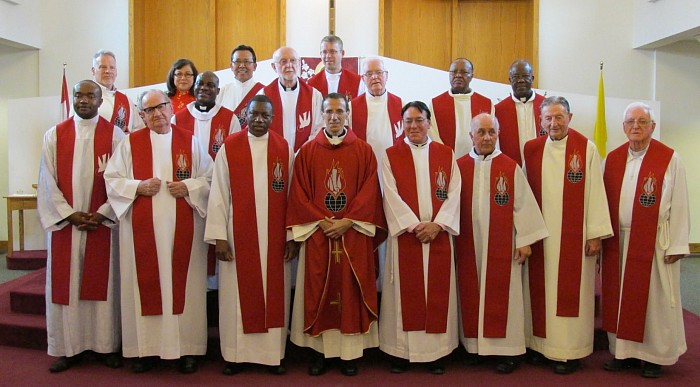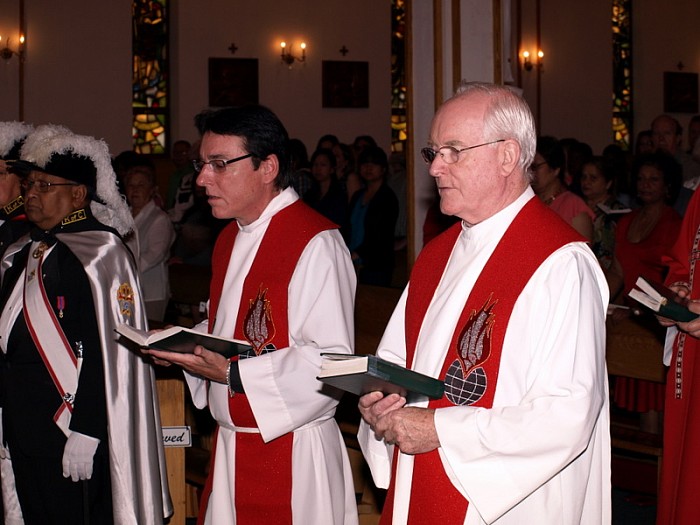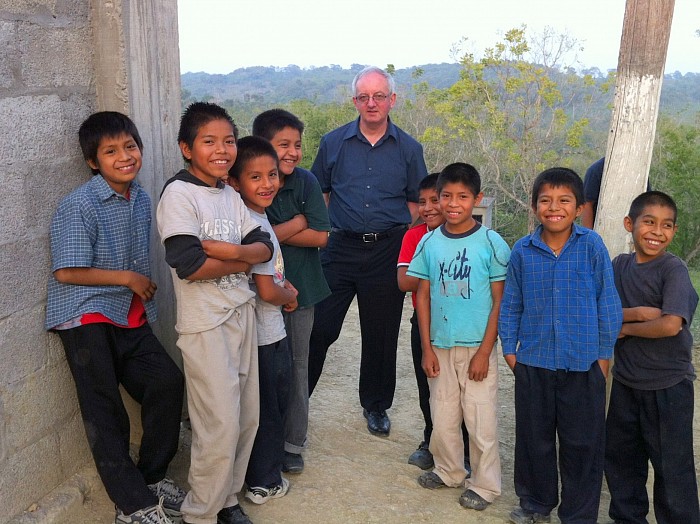
Welcome to the site of the TransCanada Province of the Spiritans. We are a Roman Catholic Religious Congregation of over three thousand members, founded in 1703. Our missions are spread worldwide. While we may be found involved in many diverse ministries, we have dedicated ourselves to working with the poor and in those situations where the Church has difficulty in finding ministers. We hope you enjoy your visit to our site and that while browsing you will keep us in your prayers. May God bless you.

Francis Libermann 1802 - 1852

Jacob Libermann:

The Early Years

 
Jacob Libermann, who would later revitalise the faltering Spiritan movement when he was elected superior general of the Congregation of the Holy Ghost in 1848, was born in Saverne in 1802. He was the fifth son of Lazarus Libermann, a rabbi in the Jewish ghetto there. Samson, David, Henoch and Felix preceded him. Samuel, Esther, Isaac and Sarah were to follow.

Ghetto Life
Jacob grew up in interesting times for the French Jews. Lazarus and his wife Leah were married in 1788. At that time the Jews in France and other European countries lived segregated and separate lives. This was particularly true in Alsace, where the Jews, unlike those in other regions of France, were of Ashkenazi origin. The Alsatian Jews were very poor, unskilled, uneducated in secular subjects. The Sephardic Jews of Bordeaux and the Jews of Avignon had acquired a modicum of prosperity and freedom but the condition of the Jews of Alsace was pitiful. Their freedom was curtailed severely in every area of life. They were forbidden to live in cities, they paid heavy taxes, they could not engage in agriculture or any craft except that of goldsmith. They could own no property except the houses they lived in. Most were restricted to
petty trade, peddling and money lending, an occupation forbidden to Catholics by Canon Law. The local population was hostile and ghettos were often subject to attacks by local mobs. It was not a very hopeful environment for Lazarus and Leah to start a family. Ghetto living produced an inward looking insecure society marked by a narrowness of outlook and a strong sense of solidarity. The Alsatian Jews saw themselves as being in a spiritual ghetto, keeping their faith in God in the midst of a decadent Christian society.

The French Revolution
Little could they have foreseen the changes the next few years would bring in the form of the French Revolution. After the fall of the Bastille, the National Assembly formulated "The Declaration of the Rights of Man" in 1789, as the basis of the new political regime. In principle at least, the Jews were liberated. But animosity to the Jews of Alsace prevented this from happening at once. Since they spoke neither French nor German but only Yiddish, they were perceived as foreign. Their monopoly on money-lending made them hated by the debt-ridden peasants. The new constitution of 1791 gave all French Jews full civic rights. They were equal now by law with every other citizen. But prejudice and resentment of the Jews did not disappear overnight and persecution continued in the confusion of the "Reign of Terror". It was during this period that Leah Libermann gave birth to her first child, Samson.
The decade of terror, from 1790 to 1800, was difficult for orthodox Jews like the Libermann family. The cult of reason and its apparent victory over religion made the right of citizenship seem a doubtful privilege. But Lazarus Libermann continued to serve his flock as rabbi and Leah continued to give birth with regularity.


Napoleonic Era
Napoleon came to power in 1800 and his first concern was to find a solution to the chaotic condition in the Catholic Church. After thirteen months of negotiation he signed a Concordat with Rome in 1801. Then he convened a Council of Jewish notables in 1802. Despite his inability to speak or read French, Lazarus Libermann was one of the three delegates from the large Jewish community in Alsace. And it was in that year that his son Jacob Libermann was born on April 12th.
The emancipation of the Jews was a shattering experience for the poor uneducated Jews of Alsace. The walls of the ghetto were falling down as trade restrictions were abolished. Many of the Jewish people were ill-equipped to take their place in a hostile Christian society. The Law of Moses was no longer the only law in their lives. Public schooling, military service and other systems of the outside world presented great challenges. Some Jews eagerly embraced the new freedoms and rejected their previous servitude. Some abandoned the Jewish faith as the power of the rabbi in the ghetto became a thing of the past. However, many stubbornly refused to accept the new culture, adhering even more strongly to the traditional ways.
For Rabbi Lazarus Libermann there was no question which branch of the road to follow. For him the Torah and the Talmud were the only way of life for a member of the chosen people. Fidelity demanded a constant fight against assimilation into the Christian world, which he saw as the main purpose of the granting of full rights of citizenship to the Jews. He hated to see the role of the Rabbi diminished as judicial power was transferred to the civil courts. As Inspector of the local Talmudic schools he realised that the young were turning their backs on the Talmud and embracing the philosophy of Liberté, Egalite, Fraternité. The republican calendar threatened the observance of the Sabbath. Obligatory military service introduced integrated living with Christians and mixed marriages were becoming more common. Lazarus was a man of deep faith, highly respected in the community. He guarded himself carefully against integration, against the position of the progressive Jews. He refused to learn the French Language and did not permit his children to do so.

Jacob's Early Years
This was the family and the environment in which Jacob spent his boyhood. The very conservative orthodox stance of his father and the family's total isolation from the Christian world meant that the heady philosophy of the revolution never penetrated into Jacob's world.
When Lazarus' eldest son, Samson, left home to pursue his rabbinical studies, he held in his hands the fulfillment of his father's dream to have a son a rabbi. But outside the closed family and community circle in Saverne, Samson soon abandoned his rabbinical studies and took up the study of medicine. By the time he qualified as a doctor he had become a "modern Jew" a disciple of Rousseau and Voltaire. He no longer believed in the religion of his father.
In the outside world, with which Jacob had no contact, things were changing ever faster for the Jewish community. Many young educated Jews like Samson became totally assimilated into French society, excited by the outburst of academic and artistic talent which marked the France of the Emperor Napoleon. Many of them totally rejected their Jewish heritage in order to facilitate assimilation into French society. Of these, quite a number, including Samson and his wife, became Christian. Four of Samson's brothers would follow the same path.
Lazarus supervised Jacob's formal education and started him early in the local Talmudic school. He learned to read and write in Hebrew and studied the books of the Torah with such intensity that he could recite the text by heart. He learned all the prayers which orthodox Jews said in the synagogue and in private. He read the great commentaries of the Bible. And since he was intending to become a rabbi he began a long period of concentrated study of the Talmud. No other interests were allowed. For eight years this study was Jacob's sole occupation.
The family was held together by Leah who directed special attention and affection towards Jacob because he was of delicate health. His childhood happiness suffered a rude shock when his mother died in 1813. But Jacob remained faithful to his heritage. In 1815, at the age of thirteen, his childhood ended with the ceremony of Bar Mitzvah. The journey of his adult life had begun.

Spiritan Missionary News, Vol. 25 No.1, Feb. 2001


Feb. 2, 1852


SURVIVING DISCOURAGEMENT
by Fr. Bernard Kelly, CSSp

 
Spiritan Missionary News
Vol. 26, No. 3, August 2002


Death of François Libermann at about 3:45pm, while the community is singing the Magnificat of the Vespers of the feast of the Purification. Père Ignace Schwindenhammer takes over as interim Superior General as Vicar General of the Congregation.


There were many sudden turnings in Francis Libermann's life. Brought up in a Jewish ghetto in Saverne, he went through a crisis of faith at the time of his rabbinical studies at Metz. At the age of 24, he was baptized a Catholic in Paris. He entered the seminary of Saint-Sulpice but the onset of epilepsy seemed to close the door on his hopes of becoming a priest. The Sulpicians were kind to him and gave him welcome at their house at Issy, where he did odd jobs and went to Paris frequently on messages. Sometimes a feeling of rejection swept over him, he found it hard to accept the hopelessness of his situation.

The nobleman who was asked what he did during the French Revolution and replied " I survived" was reporting no mean achievement. Today, in an age of "disposables"' survival is also an achievement. Amid the pressure of the modern world, the prospect of our same, everyday, average life stretching out before us sometimes blurs the importance of survival. It was when Liberian's interest in survival was at its lowest that most hung in the balance. In his temptation to suicide he could not have guessed that the most creative part of his life was still to come. Ten years later, when God wanted a missionary leader, Libermann was still around, now with special qualities that had developed in the dark days; courage and compassion and a refusal to be overcome by discouragement.

Libermann regarded discouragement as " the universal evil" in the Christian life. This was not a theory that he plucked from the sky, but a truth that he learned the hard way. From personal experience he knew the havoc that discouragement could wreak. The momentum of his personal life had been cruelly halted by the onset of epilepsy. He experienced contradictions and failure on the way to establishing his missionary society. In Rome in 1840, his partner in the enterprise became discouraged and abandoned the project.

The following extracts from Libermann's letters to the Superior of the Convent of the Immaculate Conception (Castres), in August of 1843, reflect the attitude of a realist at war with discouragement. Faced with a world where good and evil grow together, Libermann saw that encouragement could not take the shape of indiscriminate affirmation. At the same time, he advocates pushing tolerance and gentleness to the limit in the service of encouragement. Encouragement heals because it reaches the heart. Encouragement liberates, it enables a person to give all that he or she has to give.

"Always remember that gentleness and persuasion penetrate into the soul, while firmness and rigour cause only an external change. Severity and direct opposition to people's evil dispositions serve merely to break them; it almost never leads to a cure. Tolerate the evil for a long time, and if, at times, you think you ought not to suffer it any longer, suffer it still, and you will see in the end that you did the right thing. You will find that you will hardly ever see happy results from severity and direct opposition.

Remember what I told you in Paris; many people are lost through discouragement. This is the universal evil especially among the devout. Sustain and encourage and you will see that Our Lord will come to your assistance."

Libermann remains to this day a model for us in times of hurt, disappointment, rejection and discouragement.


    Spiritan Anniversary Diary
    Published by
    The Generalate of
    The Congregation of the Holy Spirit
    2002
    p. 40


     Death of Fr. Francis Libermann


"At half past three in the afternoon, as I told you yesterday, our dear Father was almost unconscious, apparently seeing and hearing nothing. This lasted until two this afternoon. Suddenly, he woke up and opened his eyes. He was shown a crucifix and we said to him, "Jesus, Mary and Joseph... In manus tuas Domine, commendo spiritum meum". He saw, understood and was transformed. It was very beautiful. We were convinced that he had had some sort of vision. They began the Magnificat in the chapel and he expired".

(Schwindenhammer).


Single? Married? Young? Old? There are many ways to serve the Lord!

YES I WANT TO FOLLOW IN THE
FOOTSTEPS OF FRANCIS LIBERMANN

Spiritans, The Congregation of the Holy Ghost
Laval House
121 Victoria Park Ave.
Toronto, Ontario
CANADA
M4E 3S2

www.spiritans.com