On a street
corner of one of Toronto's east end neighbourhoods stands Laval
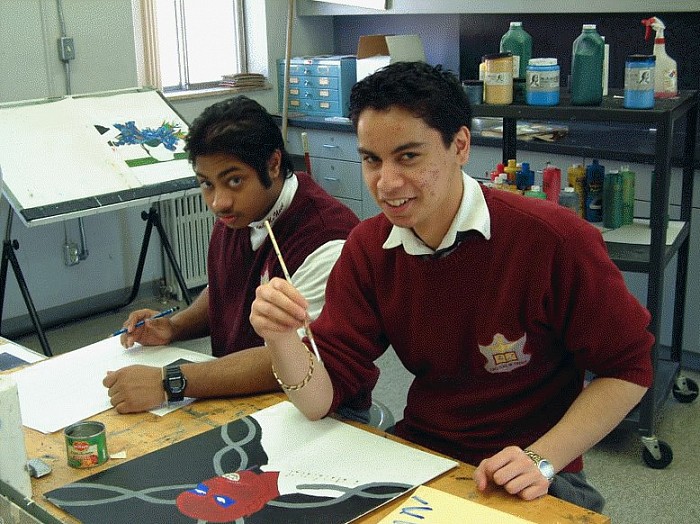
House. Each day hundreds of boys from Neil McNeil high
school pass by this house and some may wonder; Who was Laval? Why is
this house named after him?
Jacques Laval was born on the eighteenth of September in the year
1803 in Normandy, France. His father was a well to do farmer and
mayor of the village and though his mother died when he was only
seven years old, Jacques never forgot her wonderful example of
Christian charity. The Laval home was always open to helping the less
fortunate neighbours and even strangers passing through town. From an
early age, growing up in such a Catholic family, Jacques wanted to be
either a priest or a doctor. He finally settled on the medical profession.
As a doctor, Jacques continued to show forth the charity that had
been instilled in him by his parents. He would often practice without
charging the usual fee. At the same time though, Jacques enjoyed a
rich social life. He loved to attend parties, dances and other
functions favoured by those of comfortable means. Slowly Jacques
began to drift away from his faith and for a time gave up the
practice of religion. Though Jacques may have temporarily forgotten
about God, God had not forgotten about Jacques. Though he was so
successful and respected, he was feeling emptiness inside. Something
was missing. Jacques began to think again about his childhood and his
dream of being a priest. Over a period of time he completely
re-examined his life.
It was a shock to his friends when at the age of 32, this
fashionable, respected country doctor left everything behind to enter
the seminary. After ordination, Father Laval was appointed to the
small country parish of Pinterville in Normandy, and there he might
have remained if God had not other plans for Jacques. A chance visit
by two of Laval's friends from the seminary sparked a whole new
direction in his life. They told him of a new ministry being started
by Fr. Francis Libermann to help the recently liberated slaves of the
colonial world. Francis Libermann, a convert from Judaism to
Catholicism had recently founded the missionary Society of the Holy
Heart of Mary for this purpose. This new society would later merge
with the Holy Ghost Congregation revitalizing it into a dynamic
missionary order. Father Laval, upon hearing of this new ministry,
and not being a person of half measures, sought permission to leave
the parish of Pinterville. Having received the blessing of his bishop
for this venture, he gave all of his possessions over to Fr.
Libermann's new society, and set off for the island of Mauritius in
the Indian Ocean knowing little of the hardships or joys which
awaited him, but trusting deeply in the God who had led him on his
life's journey thus far. He would never see the countryside of France again!
Fr. Laval arrived in Mauritius on September 14, 1841. He had little
idea of the enormity of the task that awaited him. Mauritius, a
British colony, was rather cool to the arrival of a French cleric.
Those few Mauritius who were church going thought Laval was quite mad
to be wasting his time with such unpromising material as former
slaves, few of whom retained any religious practice, and were
certainly not flocking to greet this foreign white priest. In spite
of this, Fr. Laval, trusting in God, set about his new ministry with
joy and enthusiasm.He was not so arrogant as to assume that people,
so recently emancipated, would listen to him just because he was a
priest. Rather, he realized that he would have to get to know them
and they would have to come to trust him. He set up a very simple
meeting room beside the cathedral in Port Louis, the capital. Rather
than speaking French, he learned their language, Creole. Rather than
living as many of the clerics did, he adopted a simple lifestyle,
fasting and sleeping on a bed of wooden crates. Laval refused to
believe the common opinion that the people he served were a worthless
rabble incapable of any good. Word of his faith, kindness, compassion
and patience began to spread. Laval awakened in them God's love and
their own sense of self worth, despite the oppression and prejudice
which was their lot on a daily basis. He asked them to help in the
revitalization of the Church on the island. Soon it was the Blacks of
Mauritius who were assuming leadership in their own communities and
in the Church. Laval's ministry showed that they were not forgotten
and they were not worthless.
Jacques Laval lived in Mauritius for twenty-three years labouring and
journeying with the people he came to love and respect dearly. When
he died there on September 9th, 1864, there were over forty thousand
people at his funeral; Catholics, Muslims, Hindus and Buddhists.
Every day in Mauritius thousands of people of all faiths visit the
tomb of Fr. Laval to pray and thank God for the life of this man. In
1977, the government of Mauritius declared September 9th, the
anniversary of Laval's death, a national holiday. In Rome, on April
24th, 1979, Pope John Paul II presided over the beatification
ceremony for Jacques Laval, the first member of the Spiritans to be
so honoured.
Perhaps Laval himself today would be a bit amused by all the fuss.
After all, was he not simply showing respect to others as his parents
had taught him, helping others as he had when he was a doctor,
listening to the pain and worries of the poor and forgotten as Jesus
had done, and offering to share the free gift of the love of God
which he had received. Laval's settled life as a doctor, his time as
pastor in Pinterville, the chance visit of his seminary friends, and
finally the enormous ministry to the people of Mauritius, ... all of
these show the hand of God at work in Jacques' life. In his own plans
for his life, could Jacques have ever imagined how God would lead him
to Mauritius to work there with such a poor and despised segment of
society? God had not forgotten the former slaves of Mauritius, nor
had God forgotten Laval when young Jacques had wandered from the
faith. God instead molded his natural goodness and kindness and sent
him to share that with the poorest of the island of Mauritius; the ex
slaves that society despised and had abandoned. Those whom society
had thought worthless and inferior became the cornerstone of a
Christian revival on the island of Mauritius. By showing love and
respect, Fr. Laval helped people whose dignity had been stolen to
regain their sense of worth and pride.